
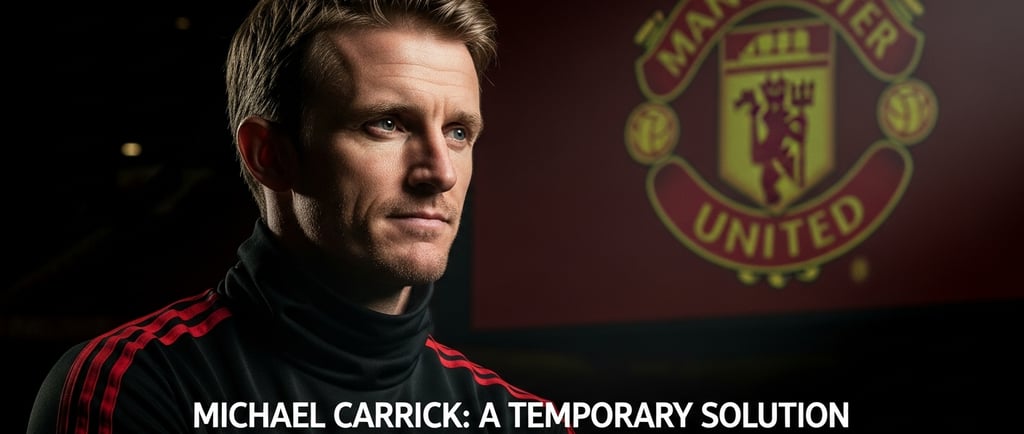
Michael Carrick: A Temporary Solution for Manchester United?
5 Unexpected Lessons from Michael Carrick’s Manchester United Stint—More Than Just a Quick Fix. Michael Carrick: A Temporary Solution for Manchester United?
SPORTS NEWS
Alibaba
1/18/20263 min read
.
1. Introduction: The Crisis at the Theatre of Dreams
Manchester United’s post-Solskjær period didn’t start with a void. The club’s history crushed any unprepared leader in this moment of institutional stagnation.
Carrick had been a long-term assistant and a quiet part of the coaching staff since 2018, but the spotlight collapsed under him during the club’s toughest time in the past ten years. His shift from a quiet tactical facilitator to a key leader is a masterclass in crisis management. We must ask ourselves: does an internal solution offer more clarity than an expensive external one?
2. Lesson 1: Cultural Equity as a Stabilising Force
Carrick was more than just a familiar face in the dugout. His “cultural DNA” gave him instant authority, built on five Premier League titles and a 2008 UEFA Champions League medal, which no outsider could match. When things are very unstable, promoting from within is often smarter, using the existing culture to keep teams stable.
Thanks to his understanding of the club’s core values, he spoke the players’ language, avoiding mid-season issues. He already knew what representing United meant. It was the historical resonance that kept things grounded amid turmoil. His first-team coach role assisted him in his move from player to coach, helping with tactics and player growth.
3. Lesson 2: Tactical Elasticity Through Discipline and Autonomy
Tactical elasticity was Carrick’s main strategic innovation, via a changed 4-2-3-1 formation. Carrick went against the norm by implementing a firm defense yet giving players more freedom in the offensive zone, unlike most interim managers. This tactic echoed the classic Ferguson approach, blending group order with individual creative expression.
Because he valued defense, the team weathered difficult periods, and “attacking transitions” gave players new confidence in finding space. This equilibrium was the key to freeing a team that was stuck by its fear. It wasn’t a formation.
4. Lesson 3: Youth as a Moral Rejuvenator
Carrick’s use of the academy for moral renewal showed a return to tradition. He incorporated talents such as Mason Greenwood and Hannibal Mejbri by drawing on the club’s history to address a contemporary morale issue. This effort went beyond just switching players around.
Believing in young players did two things: it revitalized the team and strengthened the “United Way” during an identity crisis. These decisions showed the academy is more than just a development tool; it’s a source of competitive strength in transitions. Carrick realized a bleak present meant looking to the future for hope.
His open communication and constructive feedback to players have cultivated a supportive environment.
5. Lesson 4: The Strategic Value of Stoic Leadership
Temperament is often as important as tactics in the Premier League. Carrick’s steady presence helped the team develop, unlike the past chaotic environment. A leader who’s unbothered is a must-have psychological defense for a team under public pressure.
The stoicism reassured the players, enabling them to focus on their performance and ignore the managerial search. The goal of crisis leadership is to protect subordinates from pressure. Carrick wasn’t just calm;
6. Lesson 5: The Perils of the “Identity vs. Resume” Dilemma
Carrick’s success caused an intriguing contradiction: his performance increased the chance of a long search for a “fixed” answer. The board had to choose between Carrick’s stability and more famous candidates. This underscored the peril of bureaucratic resistance: the possibility that a quest for “perfection” could undo the improvements brought about by a “stop-gap” measure.
It wasn’t just a matter of tactical records. Though new hires introduce new ideas, they don’t always grasp the club’s vision like Carrick did. The need to discover someone new could mean focusing on the short-term instead of Carrick’s plans.
Carrick and Man United’s future hinges on short-term gains versus long-term ambitions.
7. Conclusion: The Foundation for What Comes Next
Michael Carrick’s time showed he was much more than a caretaker. He brought a lost team back on track during a period of change through unity and discipline. The Manchester United leadership learned a difficult lesson during his brief stay.
Looking ahead, the club wonders: does managerial success depend on external trophies or on preserving the club’s identity? The answer, as Carrick’s mission implies, is sometimes in the building.