
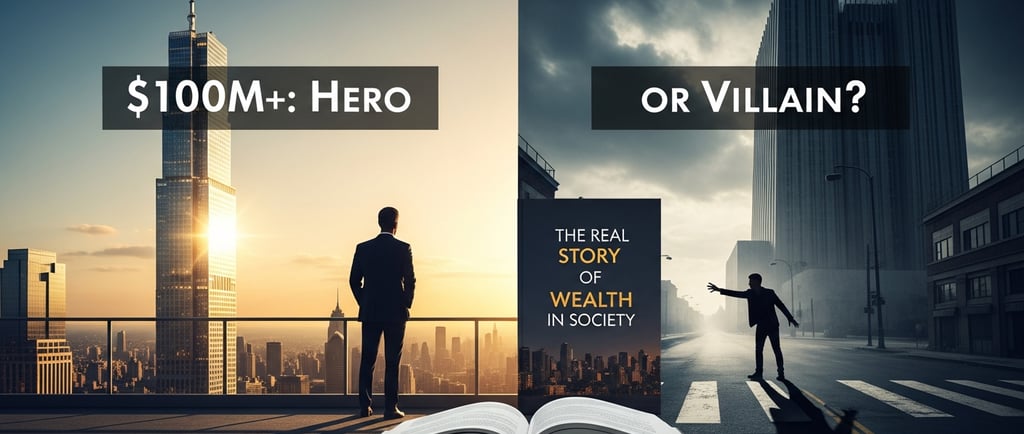
$100M+: Hero or Villain? The Real Story of Wealth in Society.
The story focuses on individuals who possess wealth exceeding $100 million. It shows how economic and technological shifts moved wealth. $100M+: Hero or Villain? The Real Story of Wealth in Society.
MONEY
Alibaba
1/15/20263 min read
The Ultra-Wealthy: 4 True Insights.
Presenting: The $100 Million Question
A nine-figure net worth is almost never achieved alone by a “self-made” individual. The digital age fixates on individuals like Elon Musk and Jeff Bezos, but this focus hides the bigger picture. Innovation amazes, inequality frustrates, but the underlying “architecture” of wealth creation often is ignored.
This architecture represents more than just a catalogue of personal victories; in doing so, we’re shifting from shallow celebrity gossip to a more profound investigation of the socio-economic forces affecting the modern world.
People build wealth; they do not just achieve it.
Understanding today’s billionaires requires recognizing wealth’s historical path, not random events. Manufacturing changes during the Industrial Revolution established the groundwork and enabled the initial large-scale private capital concentrations. These innovators accomplished more than just building businesses;
Andrew Carnegie and John D. Rockefeller were key figures, building fortunes through steel and oil. These people not only changed their fields but also affected the world.
This change wasn’t an immediate shift from oil derricks to iPhone apps. In the mid-20th century, the expansion of global trade connected and sped up worldwide wealth. These developments created the foundation for the tech boom of the late 20th century, which relied less on talent and more on venture capital and rapid market penetration. The increase was because of market deregulation and tax policies that helped the ultra-wealthy increase their wealth. History and systems shape today’s billionaires as much as their vision does.
Hero-villain is not a true opposite.
Society sees the ultra-wealthy in a split way, forcing a choice between beneficial and evil. We honor these individuals as heroes who stimulate international interaction, boost economic expansion, and produce millions of jobs. We portray them as the bad guys who make the economy’s problems worse and control democracy. Scrutiny of labor practices and environmental effects has intensified.
The reason we stick to this binary is straightforward: it simplifies things. A society finds it easier to take sides, either praising or condemning, than to address the difficult underlying structures enabling that wealth. We avoid the difficult discussion of the systems that cause power imbalances by focusing on character. We need to accept the uncertainties and acknowledge the different goals and results of the ultra-rich. Job creators and environmental destroyers are often the same companies, and we need to see both aspects at once to understand their impact.
Giving Can Be a Tool for Influence, Not Just Good Deeds.
While more money flows into health and climate philanthropy, this creates a strange situation: the solution for inequality. Though the Giving Pledge helps with suffering, it could also be a tool for managing public perception. Good works by the rich can legitimize wealth and move public talk away from big reforms.
This leads to a considerable “mismatch” between the funder’s priorities and the community’s needs. Rich philanthropists’ priorities may not always match what communities require. This kind of mismatch can cause programs to serve funders’ goals, not the intended beneficiaries.
When a billionaire’s interest warps innovation, we receive solutions from above that ignore local needs. For instance, a philanthropist could fund a high-tech education program because of their tech-focused beliefs, neglecting crucial local needs like teacher salaries or student meals. A few private donors, not the people, decide “the public good” in this developing environment.
The Two Sides of Ethical Responsibility.
Given extreme wealth, we must ask: what is the debt of the rich to society? A significant ethical challenge arises from the rising expectation that the affluent tackle societal problems, such as poverty. Private donations can fill safety net gaps, but they could hide the actual issues. This prompts us to question if large donations fulfill a moral duty or if they’re just a way for donors to feel better while keeping the system in their favor.
This wealth’s influence reaches governmental bodies, affecting policy and administration. The influence of private wealth on policy threatens accountability and democratic fairness. If we depend on the kindness of a few to resolve issues for many, wealth could decide our future direction, not the democratic process.
In conclusion: Is a New Social Contract Possible?
Our findings show that extreme wealth is not a solitary accomplishment. Ambition and societal choices have shaped wealth, from past industries to today’s tech. Considering the future, we need to assess whether our present wealth model and its related influence reflect our shared aspirations.
Who should decide our collective future: the rich or the people?